
POINTS OF SLUDGE TRANSFER IN WASTEWATER TREATMENT PLANTS
In primary, secondary, and tertiary treatment of wastewater, sludge management is critical to maintaining efficiency and environmental compliance. Sludge transfer points represent key stages in wastewater treatment where solids collect for further processing, dewatering, or disposal.
Understanding desludging ensures smooth plant performance, prevents blockages, and optimizes energy usage. It will also help you to select the right sludge transfer pumps. This article explores the essential points of sludge transfer and their role in the overall sludge management.
PRELIMINARY TREATMENT
Screened Influent to Primary Clarifier
Viscosity: 10–80 cP | Total Suspended Solids: 200–1,000 mg/L
After bar screening and grit removal, wastewater pumps move the semi-viscous influent to the primary clarifier.
These pumps must have the ability to handle variable viscosities and solid particles.
PRIMARY TREATMENT OF WASTEWATER
Solid removal: Up to 50%
CBOD removed neutralized using flocculants: 35%
Gravity-Thickened Sludge Transfer
Viscosity: 150–2,000 cP | Solids Content: 2–5%
Sludge settled at the bottom of the primary clarifier is thick and often contains fibrous material. The first step in wastewater treatment is transferring this 50% of the primary sludge to holding tanks or further treatment units. Pumps that transfer them should have a non-clogging design and low-shearing properties.
Transfer to Sludge Thickener
Viscosity: 500–5,000 cP | Solids Content: 4–8%
The partially dewatered sludge from the primary clarifiers moves to thickening units. Here, they remove the water to increase the solid concentration. During the thickening process, it is vital to preserve the floc structure. This calls for pumps with a low-shear design.
Flotation Sludge Transfer
Viscosity: 50–300 cP | Solids Content: 1–3%
The sludge formed in Dissolved Air Flotation (DAF) Systems is light, frothy, and often unstable. Bubbles attach to the sludge particles and rise to the surface, forming a thick layer on top of the tank. Sludge pumps must skim off this layer.

SECONDARY TREATMENT OF WASTEWATER
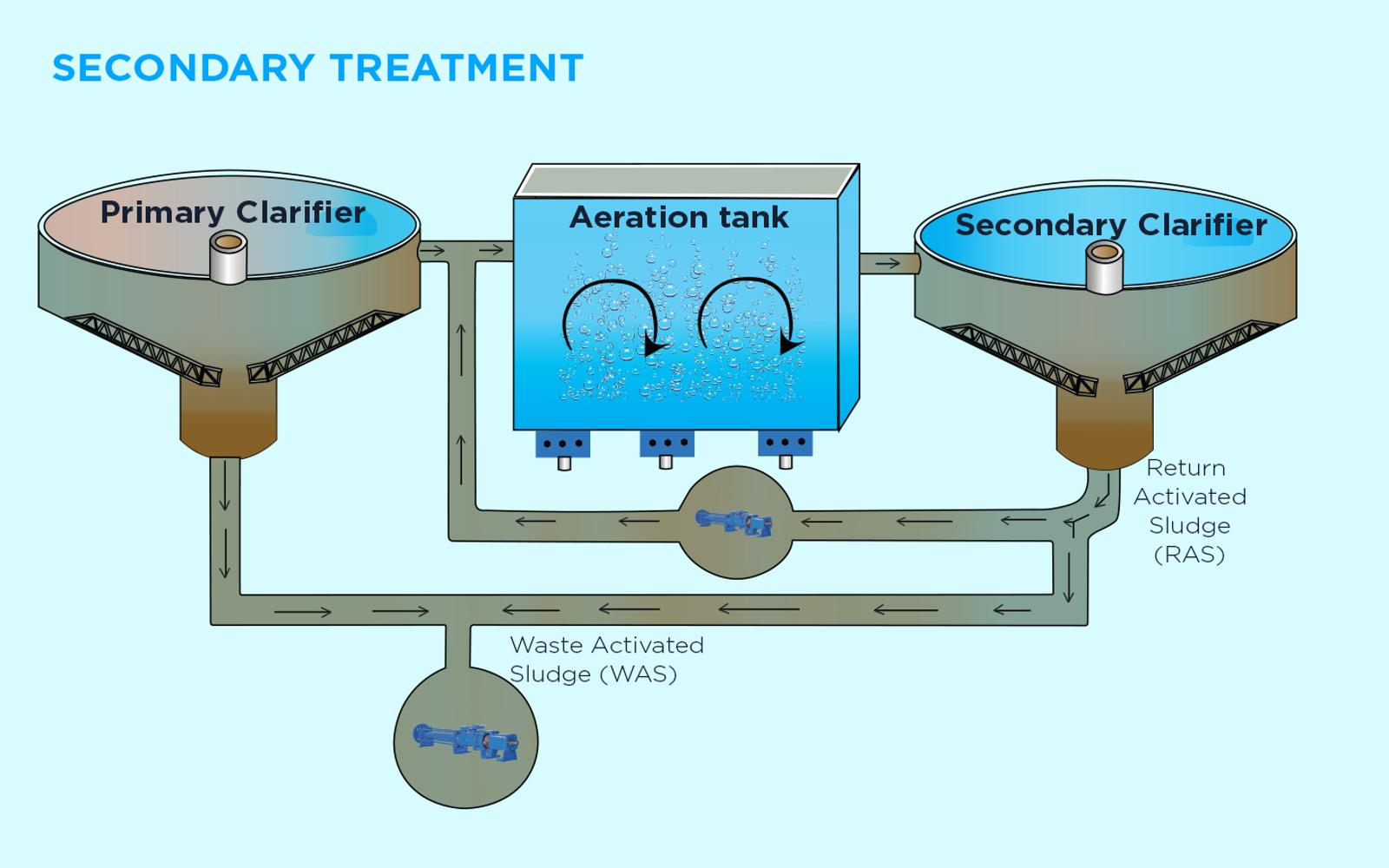
Secondary treatment of wastewater reduces Biological Oxygen Demand (BOD). The Activated Sludge System generates two types of sludges.
Activated Sludge System
Viscosity: 40–150 cP | Mixed Liquor Suspended Solids (MLSS): 2,000–5,000 mg/L
The biomass generated by aerobic bacteria and flocculants settles in the secondary clarifier as a secondary sludge. We must recycle the Return Activated Sludge (RAS) back to the aeration tank. We must also transfer Waste Activated Sludge (WAS) to further processes.
- Return Activated Sludge (Viscosity: 60–200 cP | Solids Content: 0.5–1.5%)
- Waste Activated Sludge (Viscosity: 60–200 cP | Solids Content: 0.5–1.5%)
TERTIARY TREATMENT OF WASTEWATER
The tertiary treatment of wastewater generates fine sludges from backwash and activated carbon sludge. These sludges contain small amounts of biological solids
Final Clarifiers (Viscosity: 80–200 cP | Solids Content: 0.5–1.2%) — an alternative to tertiary treatment — to remove additional sludge and further reduce suspended solids.
AEROBIC DIGESTION
Viscosity: 3,000–10,000 cP | Solids Content: 4–8%
After primary, secondary, and tertiary treatment of wastewater, the thickened sludges move to digesters.
Anaerobic digestion subjects the organic materials to pulping and batch processing before entering the digestors.
These processes produce semi-solids of various viscosities, and treatment plants must use pumps that are suitable.
Common Effluent Treatment Plants (CETP) usually add off-site food waste, fats, and grease to the digesters.
SLUDGE DEWATERING
Viscosity: 20,000–80,000 cP | Solids Content: 18–35%
Wastewater treatment plants remove high water content from the sludge in storage tanks to minimize volume. Common dewatering technologies include:
- Centrifuging (15-16 bar)
- Filter Pressing (0.2 to 1 bar)
- Belt Pressing (0.5 to 2 bar)
Dewatered sludges have less than 50% water and are hard to transfer. These are solid-rich sludges that have high viscosity.
SLUDGE DISPOSAL
Viscosity: Up to 150,000 cP | Solids Content: 30–45%
After dewatering, the sludge must be prepared for safe disposal or resource recovery. Tertiary treatment of wastewater needs reliable sludge transfer pumps to dispose high viscous sludges with high solid content. Here are a few popular sludge disposal ways.
- Land applied
- Landfilled
- Burning
These three methods involve the transportation of sludge from the dewatering units to transport vehicles.

PROGRESSIVE CAVITY PUMPS ARE GREAT FOR SLUDGE MANAGEMENT
Almost all wastewater treatment steps produce huge amounts of sludge.
The first step in sludge management is learning the sludge transfer points in ETPs and STPs. This will improve efficiency, improve resource allocation, and help with strategic planning.
Sludge pumps should handle a wide range of viscosities, high solids content, and shear-sensitive biological material.
Progressive Cavity Pumps (PCPs) are great sludge pumps because they are positive displacement pumps that generate a smooth, low-pulsation flow by rotating a double-helical, eccentrically mounted rotor within an elastomer stator. They operate at low speeds while delivering high torque.
This puts them well ahead of the usual high-viscosity transfer pump technologies like centrifugal pumps, vacuum pumps, etc. Their maintenance is relatively easy due to fewer moving parts and predictable wear patterns. Do you want to learn more about PCPs?
Reach out to us